
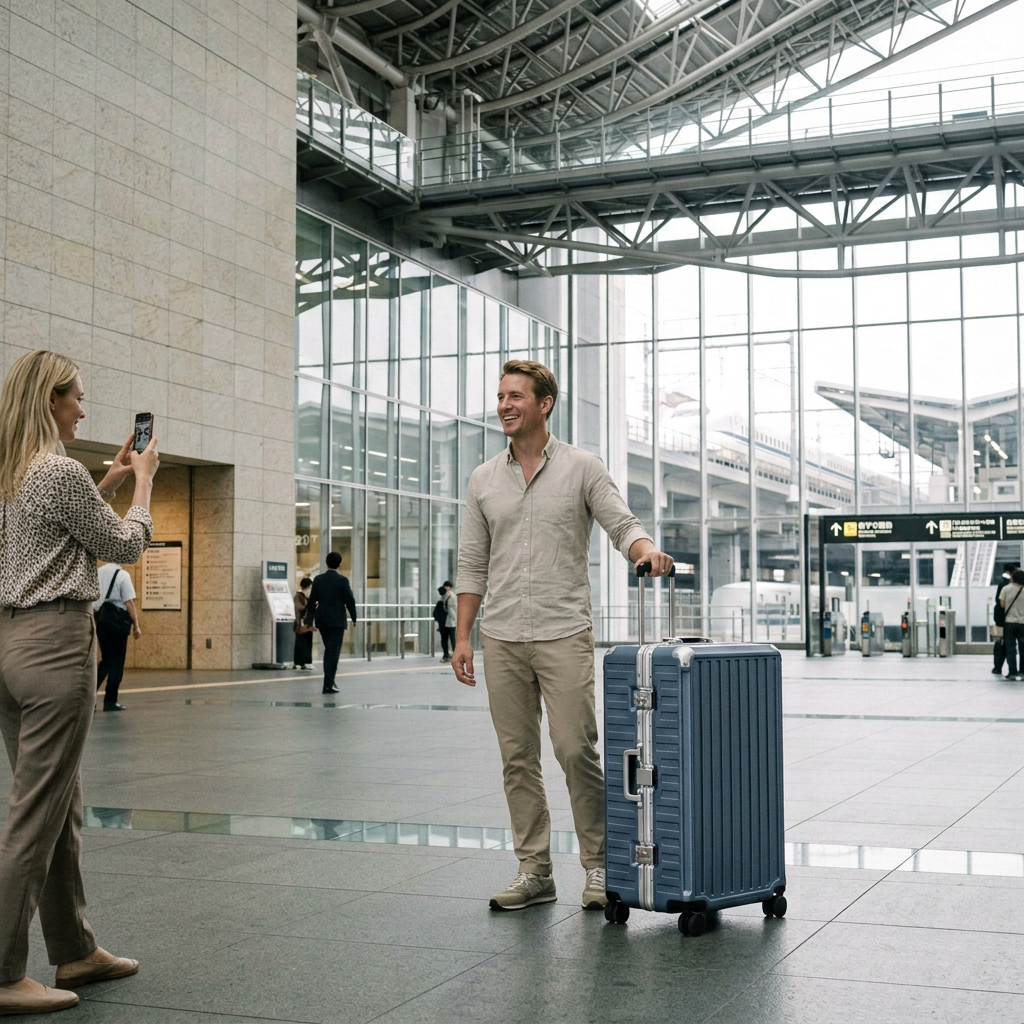
Here’s the trap with checked luggage:
You buy a bigger suitcase because you want more space.
Then you fill the space.
Then you get to the airport and discover that the suitcase fits everything—but the airline doesn’t love what it weighs.
At LUGGEX, we think checked luggage makes more sense when you treat it as a three-way trade-off:
Space.
Empty weight.
Airline limits.
Getting one right doesn’t automatically solve the other two.
Start With the Three Numbers That Matter
When comparing checked luggage, look at:
| What to Check | Why It Matters |
|---|---|
| External dimensions | Determines whether the suitcase falls within the airline’s size rules |
| Empty suitcase weight | Uses part of your total weight allowance before you pack anything |
| Capacity | Tells you how much can physically fit—not how much the airline will let you carry at standard rates |
That last distinction is the one travelers often miss.
A 100L suitcase does not give you 100L of “free” packing.
It gives you the physical room to pack more.
The airline may still care far more about the final number on the scale.
The 50-Pound Problem
For many standard U.S. checked-baggage situations, 50 lb / 23 kg is a common weight threshold.
American Airlines currently lists 50 lb for standard checked baggage across most regions, while Delta lists standard domestic checked bags under 50 lb. Southwest also uses 50 lb as its standard checked-bag weight limit. Rules differ by route, fare, cabin and status, so those numbers should be treated as common reference points—not universal rules.
Here’s the simple math:
Airline allowance − empty suitcase weight = theoretical room left for your belongings.
If your suitcase weighs 12 lb empty and your relevant limit is 50 lb, you have roughly 38 lb left before reaching that threshold.
That doesn’t mean you should aim for exactly 49.9 lb.
A little margin is useful because scales can differ and you may add something during the trip.
Bigger Luggage Makes Overpacking Easier
This is the strange thing about capacity:
More space feels helpful until you start using all of it.
A larger suitcase can be exactly right for:
-
winter clothing,
-
boots,
-
longer stays,
-
family packing,
-
relocation,
-
or bulky but relatively light items.
But if you fill that same space with dense items—shoes, books, toiletries, equipment—it can reach the airline’s weight threshold long before it looks full.
So the question shouldn’t simply be:
“What is the biggest suitcase I can buy?”
Try:
“What size gives me enough room without encouraging me to carry weight I don’t need?”
Size Limits Are a Separate Problem
Even if your suitcase weighs only 40 lb, it can still be oversized.
Many major U.S. airlines currently use 62 linear inches as a standard checked-bag size threshold.
Linear inches means:
Length + Width + Height
And you need to measure the full exterior case, not only the packing compartment.
Southwest explicitly states that wheels and handles should be included in that measurement. American and Delta likewise calculate checked-bag limits from total outside dimensions.
That matters especially when you move into extra-large luggage and trunk formats.
A suitcase can be perfect for a road trip and still be a poor choice for a flight with strict standard-baggage limits.
Think of Checked Sizes by Travel Job
Instead of assuming every traveler should go as large as possible, think about what each size is trying to accomplish.
24″ — When Manageability Matters
A medium check-in is often enough for travelers who need more than a carry-on but don’t routinely pack for extended trips.
The current LUGGEX ZX 24″ is positioned around medium-length travel with 71.7L of packing space.
Best for: travelers who want checked capacity without automatically moving into a large-case packing mindset.
26″ — When 24″ Feels Tight but 28″ Feels Like Too Much
The current ZX 26″ sits between those two sizes at 82L and a listed empty weight of 12 lb.
That makes it useful for travelers who want more room but still care about keeping the case manageable.
Best for: longer vacations, seasonal clothing and travelers looking for a middle step.
28″ — When Capacity Becomes the Priority
The current ZX 28″ offers 103L of space.
That can make sense for longer trips, winter clothing and travelers carrying bulkier items.
But the larger the interior, the more disciplined you may need to be with packed weight.
Best for: travelers who genuinely use large-volume space rather than simply filling it because it’s there.
30″ and 32″ Trunks — When Airline Fit Is No Longer the Only Priority
Large trunk-style luggage serves a different job.
The current ZX 30″ focuses on a deep packing compartment for extended stays and bulky items.
The ZX 32″ goes even further at 130L and 14.6 lb empty—and LUGGEX explicitly warns that it may exceed standard airline checked-baggage dimensions.
That doesn’t make it a bad suitcase.
It makes it a specialized suitcase.
For road trips, relocation, extended stays, cruises or family packing, maximum interior space may matter more than fitting within standard airline size thresholds.
For frequent flying, it may be too much.
That’s the trade-off.
A Better Way to Pick Your Checked Bag
Before choosing a size, ask yourself three things:
What do I usually pack?
Bulky jackets need volume. Books and shoes eat weight.
How often do I fly versus drive or take rail trips?
Airline rules matter much more when flying is the primary use case.
How much margin do I want before the weight limit?
If you routinely come home with souvenirs, starting the trip at 49 lb is probably not a great strategy.
Weigh the Bag Before You Leave Home
This sounds obvious.
A surprising amount of baggage stress happens because travelers weigh the suitcase for the first time at the airport.
Pack normally.
Then weigh the entire suitcase.
If you’re close to the airline’s threshold, make the adjustment at home—where you can decide what stays behind without an audience waiting at the check-in counter.
And always re-check the operating airline’s current rules before departure.
Routes, fares, cabin classes, loyalty status and international itineraries can all change baggage allowances.
So What Is the “Right” Checked-Luggage Size?
The right suitcase is not the one with the highest capacity.
It’s the one that gives you enough room without creating a new problem.
For some travelers, that means a 24″.
For others, 26″ is the sweet spot.
Heavy packers may genuinely need a 28″.
And travelers heading on road trips or extended stays may get far more value from a trunk than someone who flies every week.
Think of it this way:
Capacity tells you what can fit.
Empty weight tells you where you start.
Airline policy tells you where the boundary is.
Good checked-luggage planning happens where all three meet.
Explore LUGGEX Check-In Luggage
Still deciding which size makes sense?
Read Our Checked Luggage Size Guide
And if you’re also comparing construction:
Zipperless vs. Zipper Luggage: Which Is Better?
LUGGEX. Make It Epic.
Share:
Why Do Suitcase Wheels Break? What Travelers Should Check Before Their Next Flight