
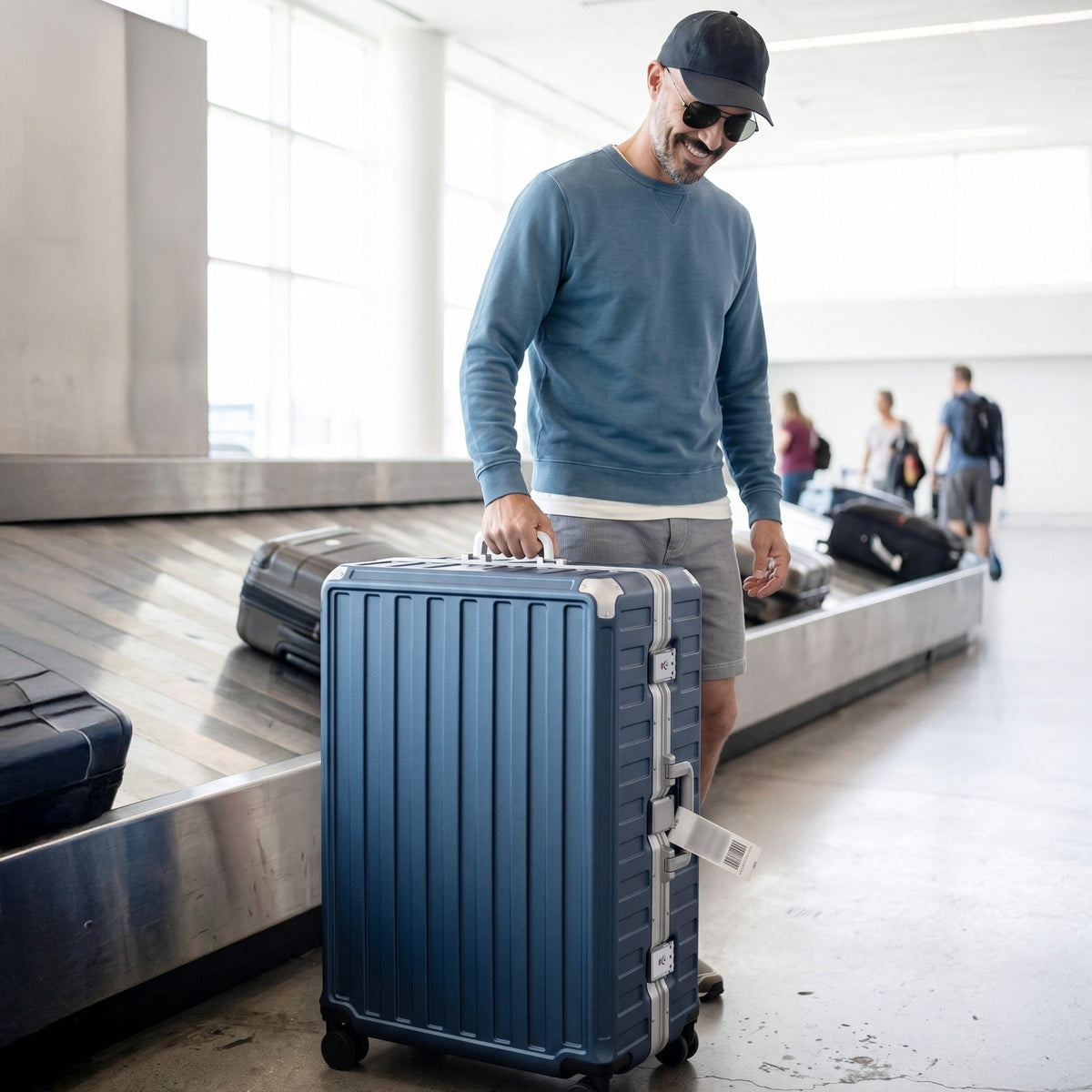
If you have ever watched your suitcase land hard on the baggage carousel, you know that air travel is not gentle on luggage.
Checked bags may be dropped, stacked under heavier cases, squeezed inside a cargo hold, or rolled across rough surfaces. This is exactly the kind of real-world travel LUGGEX designs around. Instead of judging durability by appearance alone, we focus on the parts that take the most punishment: the shell, frame, corners, wheels, handles, and locks.
So, what should you actually look for when choosing durable luggage?
1. Start With the Shell Material
Two hard-shell suitcases can look nearly identical and perform very differently after a hard impact.
For frequent travel, 100% polycarbonate is one of the strongest all-around choices. Unlike more brittle plastics, quality polycarbonate can flex under pressure and recover its shape. That helps the shell absorb impact instead of cracking immediately.
ABS luggage is usually lighter and less expensive, which may be enough for occasional trips. However, travelers who check bags frequently should look for clearly labeled 100% polycarbonate—not vague terms such as “PC blend” or “polycarbonate finish.”
For a deeper material comparison, read What Is Polycarbonate? Why PC Luggage Beats ABS.
2. Examine the Closure System
The closure runs around the center of the suitcase, making it an important structural area.
Traditional zippered luggage is usually lighter and may offer expandable capacity. The tradeoff is that zipper tracks can snag, split, or experience added strain when the suitcase is overpacked.
Zipperless luggage replaces the fabric zipper with a rigid frame and latch-style locks. An aluminum frame helps the suitcase maintain its shape and creates a more structured closure.
Neither option is right for everyone:
-
Choose zippered luggage if low weight and expansion matter most.
-
Consider a zipperless aluminum frame if you prioritize structure and want to eliminate zipper-related failure points.
3. Look for Reinforced Corners
Corners often take the first hit when a suitcase is dropped.
Because the force is concentrated in a small area, unprotected corners may be more likely to crack, dent, or lose alignment. Reinforced corner guards help absorb and distribute that impact across a wider area.
This is especially important on checked luggage, which is usually larger, heavier, and more exposed to rough handling.
4. Do Not Overlook the Wheels
A suitcase can have a strong shell and still become difficult to use if a wheel breaks.
Look for four multidirectional spinner wheels, reinforced wheel housings, stable mounting points, and smooth movement under weight. Shock-absorbing wheels can also help reduce vibration when rolling across sidewalks, carpet, and uneven airport flooring.
Do not judge the wheels only by spinning an empty suitcase. The real question is whether they remain stable and smooth when the case is fully packed.
5. Test the Handles
A telescoping handle should extend smoothly, lock securely at each height, and feel stable when the suitcase is loaded.
A small amount of movement is normal because the tubes need clearance to extend and retract. Excessive wobbling, sticking, or twisting can be signs of weak rails or poor mounting.
Also check the top and side carry handles. Airport staff and travelers frequently lift checked luggage by these points, so reinforced handle mounts matter.
6. Look for Testing, Not Just Marketing Claims
Words such as “rugged,” “premium,” and “heavy-duty” are easy to print on a product page. Specific testing provides more useful evidence.
LUGGEX subjects its luggage to more than 20 quality checks focused on the components travelers rely on most. Published ZX Series testing includes:
-
50 tumble rotations to evaluate the shell, frame, and corners under repeated impact.
-
8,000 meters—about five miles—of wheel testing with a 31 lb load.
-
10 temperature-conditioned drop tests from 31.5 inches with a 44 lb load.
These tests do not make any suitcase indestructible. Extreme impacts can damage even well-built luggage. However, clearly stated testing conditions provide more confidence than an unsupported durability claim.
You can review the published details on the LUGGEX Quality Testing page.
How LUGGEX Builds for Real Travel
LUGGEX combines a 100% polycarbonate shell with a reinforced zipperless aluminum frame, integrated TSA locks, protected corners, and shock-absorbing spinner wheels.
The goal is not to rely on one impressive feature. It is to build a complete system in which the shell absorbs impact, the frame supports the closure, the corners protect vulnerable areas, and the wheels continue moving under load.
The LUGGEX Zipperless Luggage Collection includes carry-ons, checked luggage, trunks, and sets designed for different trip lengths.
What Durable Luggage Cannot Promise
No suitcase is completely damage-proof.
Polycarbonate can still scratch. Aluminum frames can dent under extreme force. Wheels and handles remain exposed, and damage caused by airline handling may not always be covered by a manufacturer’s warranty.
More protective construction can also mean tradeoffs:
-
A reinforced frame may add weight.
-
Zipperless luggage is usually non-expandable.
-
Fixed-capacity cases require more disciplined packing.
-
Cosmetic scuffs are still normal after checked travel.
The goal is not to find an indestructible suitcase. It is to choose one whose materials, construction, and testing match the way you travel.
Final Thoughts
Durable luggage is more than a hard shell.
Before buying, check the shell material, closure, corners, wheels, handles, testing information, and warranty terms. For frequent checked travel, prioritize 100% polycarbonate, reinforced impact areas, load-tested wheels, and a closure designed to remain secure under pressure.
Good luggage should not need to look perfect after every flight. It should continue protecting your belongings, closing properly, and rolling smoothly trip after trip.
Frequently Asked Questions
What is the most durable material for hard-shell luggage?
For many travelers, 100% polycarbonate provides a strong balance of impact resistance, flexibility, weight, and long-term durability. Aluminum offers greater rigidity but is generally heavier and more likely to show dents.
Is zipperless luggage more durable?
Zipperless luggage removes zipper teeth, sliders, and fabric tracks from the main closure. This eliminates several potential failure points, but overall durability still depends on the frame, shell, locks, wheels, handles, and construction quality.
Can any suitcase survive all airport baggage handling?
No. Extreme impacts can damage any suitcase. Better materials, reinforced components, and realistic testing can reduce risk, but they cannot guarantee complete protection in every situation.
Internal links:
Commercial Page
LUGGEX Zipperless Luggage Collection
https://www.luggex.com/collections/zipperless
Supporting Guide
What Is Polycarbonate? Why PC Luggage Beats ABS
https://www.luggex.com/blogs/epictravel/what-is-polycarbonate-why-pc-luggage-beats-abs
Share:
Why Do Luggage Zippers Break—and Can Zipperless Luggage Solve the Problem?
How to Pack for Changing Weather: 7 Essential Travel Tips