
A suitcase can look great in photos and still become frustrating the first time something goes wrong.
One wheel starts dragging.
The telescoping handle suddenly feels loose.
The frame no longer closes as cleanly as it did out of the box.
That’s why LUGGEX thinks “durable luggage” deserves a more useful explanation than tough, rugged, or built to last.
Durability isn’t one feature.
It’s the result of several high-stress parts working together trip after trip.
If you’re comparing luggage, here are the areas worth looking at before you buy.
The Quick Durability Check
| Part | What to Look For | Why It Matters |
|---|---|---|
| Wheels | Stable mounting, smooth rotation, minimal unwanted wobble | Wheels take repeated impact, vibration and directional changes |
| Telescoping Handle | Clean extension, secure locking positions, controlled side-to-side play | The handle repeatedly carries pushing and pulling force |
| Carry Handles | Secure attachment points and comfortable lift | These points take the load when you lift a packed suitcase |
| Frame / Closure | Even alignment, solid latches or a well-supported zipper path | The closure has to stay aligned while the case is packed and moved |
| Corners & Shell | Reinforced high-contact areas and a shell that suits your travel style | Corners often take direct bumps during handling |
| Warranty & Service | Clear coverage, exclusions and a real support path | Even well-designed moving parts can eventually need attention |
The point isn’t to find luggage that can never fail.
It’s to understand where luggage usually works hardest.
1. Start With the Wheels
If there’s one part worth paying attention to, start here.
A suitcase spends much of its travel life on its wheels. They turn through airport terminals, parking garages, sidewalks, hotel floors and uneven pavement while carrying the weight of everything you packed.
And a wheel problem is hard to ignore.
A beautiful suitcase with one wheel that won’t roll properly becomes a very different travel experience.
What should you check?
First, roll the suitcase with all four wheels on the floor.
The wheels should rotate and change direction without one corner noticeably resisting the others.
Then gently move each wheel by hand.
You’re not looking for absolute zero movement—moving assemblies can have some normal play. You’re looking for anything that feels dramatically looser, rougher or less controlled than the other wheels.
Also look at how the wheel connects to the suitcase.
The wheel itself matters, but so does the housing and mounting point holding it to the case.
Don’t judge wheels by smoothness alone
A wheel that feels incredibly smooth across a showroom floor may feel very different on broken pavement.
So when brands talk about suspension, shock absorption or specialized wheel systems, ask:
What problem is that design actually trying to solve?
For example, current LUGGEX ZX models use a shock-absorbing spinner-wheel design. That is a specific construction feature—not permission to call the suitcase “indestructible.” The value is that the wheel system is designed around reducing vibration during movement.
That distinction matters.
2. Check the Telescoping Handle More Than Once
Most people test a suitcase handle like this:
Pull it up.
Push it down.
Done.
Try again.
Extend it several times.
Check every locking position.
Push the suitcase forward, pull it back and gently change direction while holding the handle.
What are you looking for?
The handle should:
- extend and retract consistently,
- lock where it is supposed to,
- release without excessive force,
- and feel reasonably controlled when changing direction.
A little movement in a telescoping handle is not automatically a defect.
In fact, assuming “zero movement = stronger” can be misleading.
What matters more is whether the handle behaves consistently and whether the rails, locking mechanism and attachment points feel properly integrated.
Why this matters
The telescoping handle acts like a long lever.
Every time you steer a fully packed suitcase, force travels from your hand down through the handle system into the case.
So don’t just ask:
“Does the handle feel nice?”
Ask:
“Does the whole mechanism feel controlled when I actually steer with it?”
3. Don’t Forget the Carry Handles
Telescoping handles get more attention.
Carry handles often get more sudden load.
Think about lifting a packed suitcase into a car trunk, onto a luggage scale, up a staircase or off a baggage carousel.
At that moment, much of the suitcase’s weight is concentrated around a relatively small attachment area.
So when inspecting a suitcase, check where the top and side handles connect to the body.
What matters?
A comfortable grip is nice.
But the more important question is:
How is the handle attached to the suitcase?
You want the handle to feel secure under a normal lift, without obvious separation or irregular movement around the mounting points.
This is also why a durability evaluation should never focus exclusively on the shell.
A very rigid shell doesn’t help much if one of the load-bearing components around it is poorly supported.
4. Look at the Frame and Closure as a System
This is where luggage construction gets more interesting.
Traditional luggage commonly relies on a perimeter zipper.
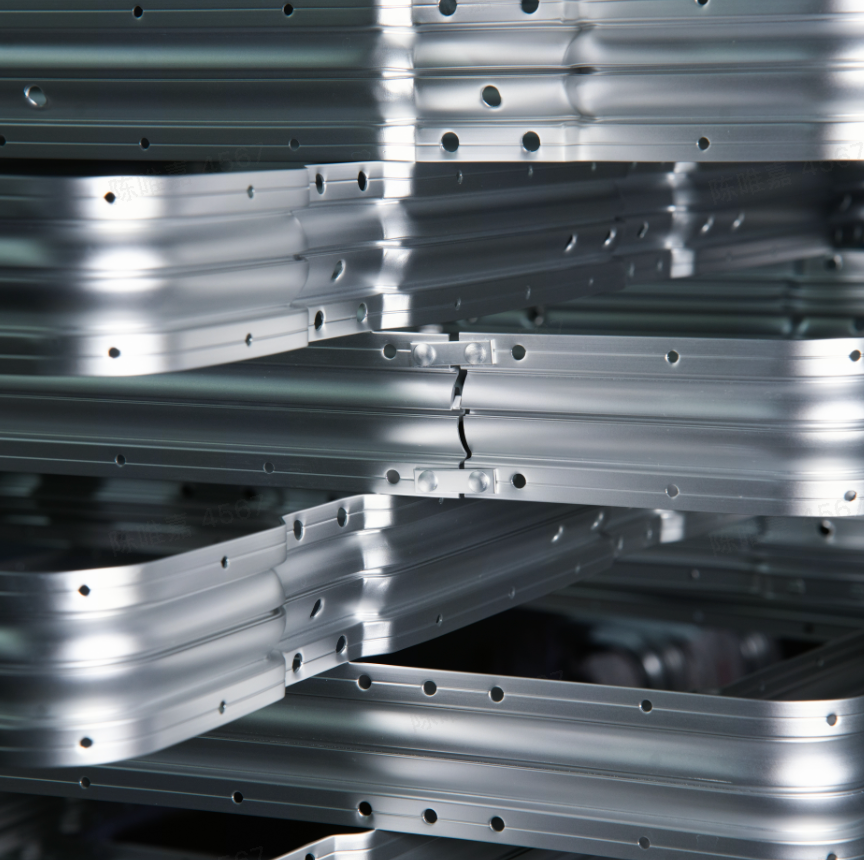
Some hard-shell luggage—including many models in the LUGGEX ZX line—uses an aluminum-frame polycarbonate hardshell with a zipperless closure instead. That wording matters: an aluminum frame does not mean the entire suitcase is made from aluminum. product-facts
Neither construction should automatically be reduced to:
zipper = bad
or
frame = indestructible
They simply create different structures—and different areas worth checking.
For a zippered suitcase, look at:
the zipper track, stitching, pulls and how much tension the zipper experiences when the case is packed.
For a framed suitcase, look at:
frame alignment, hinges, latches, locks and whether both halves meet evenly when the case closes.
A rigid frame may eliminate the main perimeter zipper, but that doesn’t eliminate every possible wear point.
The stress simply moves to different components.
A useful test at home
Close the suitcase empty.
Then pack it normally and close it again.
The two sides should still align without requiring you to force one corner into position.
If you have to sit on the case every trip just to make the closure meet, you may be asking the structure to handle more pressure than it was designed for.
5. Shell Material Is Only Part of the Story
Polycarbonate. Aluminum. ABS.
These words are easy to put into a comparison table.
They’re harder to turn into a simple ranking.
Why?
Because a material name alone doesn’t tell you everything about how a suitcase is constructed.
Shape, thickness, reinforcement, corner design, mounting points and how all the components interact can matter too.
That’s why we’d be cautious with statements such as:
“This material means the suitcase will last longer.”
Without a controlled comparison, that’s too broad.
For LUGGEX products confirmed as aluminum-frame polycarbonate hardshells, that construction can be stated directly. But the material itself should not be stretched into unsupported performance claims. product-facts
A better buying question is:
How are the high-impact areas designed?
Look at the corners.
Look at the wheel mounts.
Look at the handle attachments.
Look at the frame or zipper path.
Those tell you more about the complete product than a material badge by itself.
6. Durability Also Includes What Happens After Something Goes Wrong
This part is easy to overlook.
Mechanical products have moving components.
Wheels rotate. Handles extend. Locks move. Hinges open.
So part of choosing luggage is understanding what happens if one of those components eventually develops a problem.
Before buying, check:
Is there a warranty?
What does it actually cover?
What is excluded?
Who do you contact?
Does the brand have a clear claim process?
For eligible ZX luggage purchased directly from LUGGEX.com, the current policy provides a Lifetime Limited Warranty, subject to its coverage terms and exclusions. That doesn’t mean every scratch, accident or airline-related damage is covered, and those limits are worth reading before purchase. product-facts
Read the LUGGEX Warranty Policy
A warranty should never replace good construction.
But clear after-sale support is still part of the ownership experience.
A 5-Minute Suitcase Check Before Your First Trip
You don’t need to stress-test new luggage in your garage.
Just use it normally before departure.
Pack it with a realistic load.
Then:
Roll it across a few indoor surfaces.
Turn it sharply in both directions.
Extend and retract the handle several times.
Lift it using the top and side handles.
Open and close it while packed.
Check every wheel, corner and attachment point one more time.
This gives you a baseline.
If something already feels unusual at home, it’s better to notice it before you’re standing in Terminal B.
So What Actually Makes a Suitcase Durable?
Not one buzzword.
Not one material.
And definitely not a product page saying “built tough.”
The parts that deserve the most attention are the ones doing the most work:
Wheels that roll and stay securely mounted.
Handles that repeatedly extend, steer and carry weight.
A closure system that stays properly aligned.
Corners and attachment points designed around real travel contact.
Support that gives you somewhere to turn if a covered issue occurs.
That’s a more realistic way to shop for durable luggage.
Because the best question isn’t:
“Can this suitcase survive anything?”
No responsible luggage brand can promise that.
The better question is:
“Was this suitcase thoughtfully built around the parts that travel puts under the most stress?”
That’s the question worth asking before your next trip.
If you’re still deciding between different types of suitcase construction, read:
Zipperless vs. Zipper Luggage: Which Is Better for Modern Travel?
And if your next question is what size you actually need:
Which LUGGEX ZX Carry-On Is Right for You?
LUGGEX. Make It Epic.
Share:
Cherry vs. Champagne Gold : Which One Feels Like the Next Big Luggage Color?