
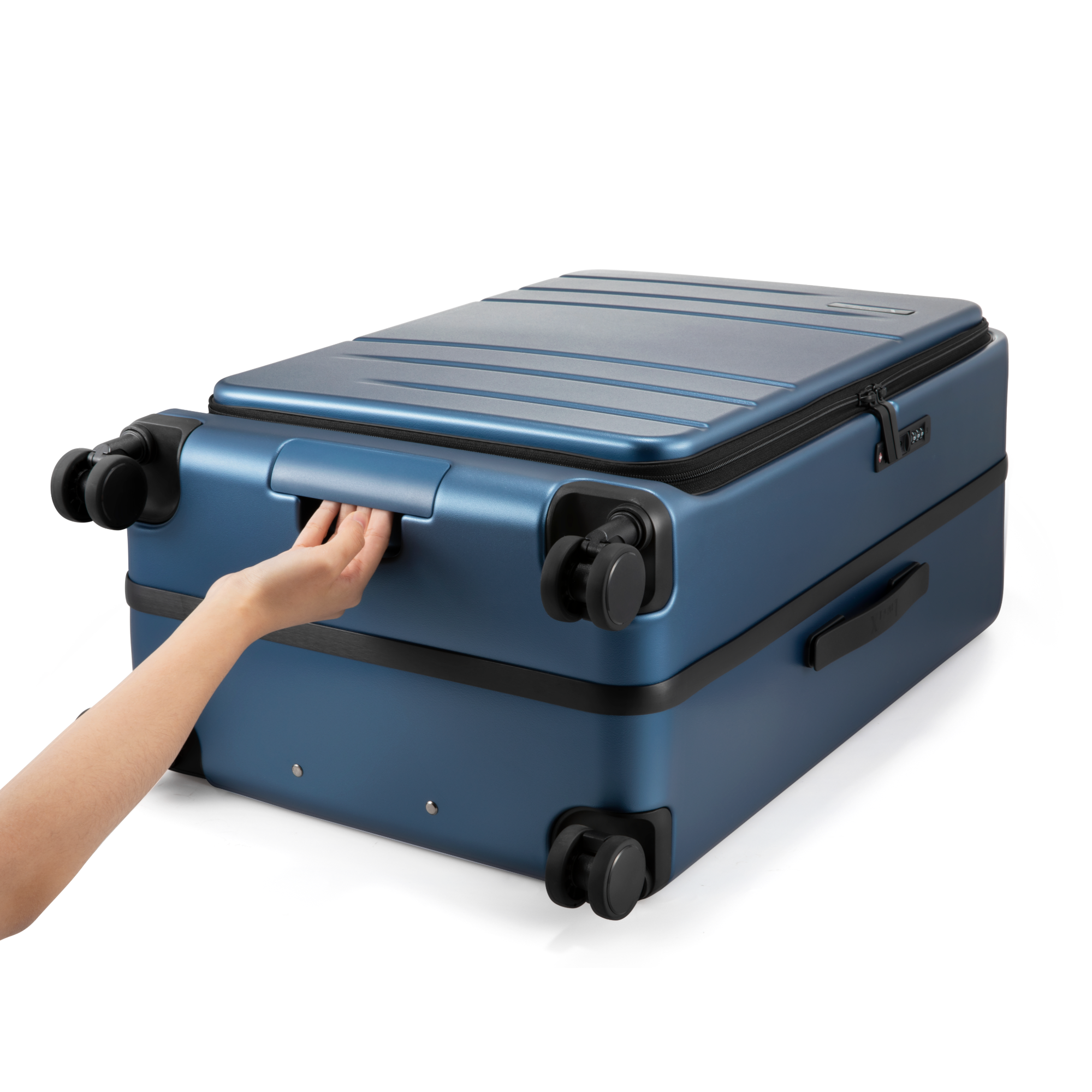
Traditional clamshell suitcases have been the standard for decades, but they are not always built for the way people travel today. In crowded airports, small hotel rooms, cruise cabins, and quick business trips, opening a suitcase flat can take up too much space and make it harder to reach what you need.
That is why more travelers are choosing front-opening and top-opening luggage. These smarter packing systems are designed for easier access, better organization, and less travel friction.
At LUGGEX, we believe smarter access makes travel simpler. Whether you need quick laptop access with a front-opening carry-on or deep packing space with a top-opening trunk, the right suitcase design can make your trip feel easier from start to finish.
Quick Answer: Which Luggage Style Is Best?
-
Choose front-opening luggage if you want fast access to your laptop, travel documents, chargers, or in-flight essentials without opening your entire suitcase.
-
Choose top-opening luggage if you want more usable packing space, easier vertical packing, and a suitcase that works better in small hotel rooms, cruise cabins, or tight spaces.
-
Choose a traditional clamshell suitcase if you prefer a classic 50/50 packing layout and usually have enough room to open your bag flat.
The Evolution of Access: Why Traditional Clamshells Fall Short
To understand why smarter opening styles are gaining significant traction among frequent flyers, it is helpful to analyze the design limitations of the traditional clamshell suitcase.
A standard clamshell design divides its storage volume equally down the center. To pack, unpack, or simply retrieve an item as small as a phone charger or a fresh change of clothes, you must lay the bag completely flat on a floor, bed, or luggage rack, opening it like a massive, spread-out book. This action immediately requires a physical floor footprint that is exactly double the actual size of the suitcase.
In a narrow hotel room, a compact cruise ship cabin, a crowded train compartment, or a busy airport lounge, clearing a wide horizontal space is frustrating and inconvenient. Furthermore, splitting a suitcase into two shallow 5-inch compartments means your items are prone to shifting, sliding, or spilling out whenever the bag is flipped open.
LUGGEX modern access designs eliminate these vulnerabilities entirely by shifting to a single-entry architecture. Instead of cutting the suitcase in half, the main body remains one deep main compartment, utilizing specialized lids to maximize access efficiency:
-
Front Opening Access: Features a heavy-duty hinged door on the forward face of the suitcase. This gives you fast, vertical access to the entire main compartment or an isolated, padded tech organizer without disturbing the rest of your packed clothing.
-
Top Opening Access: Employs a perimeter lid closure positioned at the very top or upper face of the suitcase, mirroring classic trunk designs. This lets you pack the bag vertically from the ground up, maximizing total usable volume while ensuring the bag opens with a smaller footprint.
Front Opening Luggage: The Business Traveler’s Secret Weapon
Front open luggage (frequently classified as front-lid access) serves as an indispensable tool for corporate commuters, digital nomads, and short-duration travelers who must remain "mobile-ready" at every stage of transit.
Core Engineering & Design Features
-
Integrated Tech Zones: Many LUGGEX front-opening carry-ons include padded tech compartments designed for laptops, tablets, and travel documents.
-
Stand-Up Accessibility: Because the primary hinge system is located near the base or along the vertical side of the outer shell, you can unlock the front panel while the suitcase remains standing completely upright on its wheels.
-
Hybrid Asymmetrical Compartments: Rather than a restrictive 50/50 division, these suitcases use a smart asymmetrical split. This pairs a shallow front door section designed for daily essentials with an expansive, deep rear well designated for bulkier wardrobe items.
Real-World Benefit: Ultimate Airport Convenience
If you have ever had to manually open a traditional suitcase at a busy TSA checkpoint, you know the frustration it causes. Laying your entire bag flat on a table exposes your personal clothing to the entire terminal while you scramble to unearth your electronic devices.
LUGGEX front-opening systems completely remove this friction. While standing directly in the security line, you simply release the front closure, smoothly slide your laptop out of its protective sleeve, and place it into the scanning bin within seconds—all without exposing your wardrobe or altering the suitcase's upright footprint.
Many premium variants integrate this front-facing compartment directly into a unified TSA combination lock system for added security and convenience.
Pros and Cons of Front Opening Systems
The Advantages
-
Instant Tech Access: Speeds up your transit time through security lines and airport terminals.
-
Upright Functionality: Allows you to pack, unpack, or audit items while the suitcase remains securely balanced on its wheels.
-
Balanced Organization: Seamlessly isolates dirty laundry or sensitive business electronics from your fresh clothes.
The Disadvantages
-
Slight Weight Adjustments: Some front-opening designs may be slightly heavier because of added panels, padding, or zipper structures. For travelers looking to minimize every single gram, the ultra-minimalist LUGGEX Underseat Luggage Guide (link coming soon) highlights lighter alternatives.
-
Fixed Lid Depth: Because the front panel houses electronics, the front lid itself cannot be heavily overstuffed without pressing inward against your sensitive laptop screen.
Shop LUGGEX front-opening carry-on luggage
Top Opening Luggage: The "Trunk" Style Revolution
While front-opening options focus on rapid laptop and tech access, top open luggage focuses primarily on maximizing packing space, handling oversized items, and minimizing the physical footprint of your luggage inside hotel rooms.
How the Trunk Architecture Operates
Think of a top-opening suitcase as a highly structured, mobile packing box or trunk. Instead of splitting the bag down the center into two shallow 5-inch halves, a top-opening configuration keeps the entire main base intact as a single, deep storage tub. The top lid itself is lightweight and highly flexible, featuring simple mesh storage pockets on its interior surface to hold smaller travel accessories.
The Real-World Benefits of Vertical Packing
-
Drastically Reduced Footprint: Because the suitcase opens from a top perimeter lid rather than a central seam, it does not require the full suitcase to be laid flat to access your gear. It fits easily onto narrow hotel luggage racks, making it better for compact hotel rooms and cruise cabins without blocking walkways.
-
Layered Packing via Gravity: Packing a deep, single-cavity trunk allows you to utilize natural gravity to organize your wardrobe. You can place heavy, rigid items like spare shoes, boots, and toiletry kits at the absolute bottom of the tub near the wheelbase. From there, you can smoothly stack lighter layers, fine knitwear, and delicate shirts toward the top to prevent crushing and minimize fabric wrinkling.
-
More Room for Bulky Objects: Traditional 50/50 suitcases often struggle to close if you attempt to pack large items, such as motorcycle helmets, thick winter coats, shoeboxes, or heavy photography equipment. A deep, top-loading trunk swallows these awkward, high-volume items effortlessly because it does not force you to split the item's depth across two separate walls.
Pros and Cons of Top Opening Systems
The Advantages
-
Exceptional Volume Efficiency: Maximizes the packing space within the bag's exterior dimensions.
-
Space-Saving Convenience: Allows you to live straight out of your suitcase in small boutique hotel rooms without spreading your suitcase across the floor.
-
Perfect for Packing Cubes: The deep rectangular shape serves as an ideal framework for stacking modular packing cubes neatly on top of one another.
The Disadvantages
-
Potential for Gear Submergence: Because you are packing items vertically from bottom to top, reaching an item placed at the very bottom of the trunk can require removing the layers sitting above it.
-
Limited External Tech Pockets: True trunk-style cases generally focus on maximizing interior clothing space, meaning they rarely feature an external, rapid-access laptop sleeve.
Shop LUGGEX top-opening trunk luggage
Head-to-Head Comparison: Front Open vs. Top Open vs. Clamshell
To help you decide which configuration best matches your personal travel style, this table breaks down how all three systems compare across key metrics:
|
Feature |
Front Opening Luggage |
Top Opening Luggage |
Traditional Clamshell |
|
Space Required |
Low. Opens upright or flat. |
Minimal. Opens with a smaller footprint. |
High. Requires the full suitcase to be laid flat. |
|
Laptop Access |
Excellent. Features dedicated external sleeves. |
Moderate. Tech must typically go inside the upper lid. |
Poor. Requires unzipping and opening the entire bag. |
|
Packing Style |
Zoned. Separates electronics from clothing. |
Layered. Organized like a deep dresser drawer. |
Symmetrical. Divided strictly into 50/50 halves. |
|
Interior Depth |
Hybrid. Shallow door with a deeper back tub. |
Maximum. One deep, continuous packing cavity. |
Shallow. Two separate, low-profile packing compartments. |
|
Best For |
Business travel, short trips, and frequent flyers. |
Long-haul tours, winter travel, and bulky gear. |
Casual travelers and uniform, flat packing. |
Real-World Packing Scenarios: Living the LUGGEX Experience
To better see how these design choices perform during actual transit, let's look at two common travel scenarios:
Scenario A: The 48-Hour Corporate Commute
-
The Goal: You land at your destination at 9:00 AM and must report directly to an important client meeting by 10:30 AM. Along the way, you need to quickly access your laptop and present a crisp, unwrinkled blazer the moment you step off the plane.
-
The Selected Tool: LUGGEX Front Open Carry-On Luggage
-
The Real-World Outcome: This design helps travelers avoid spreading their suitcase across the floor or finding a private restroom just to open it. Instead, you smoothly unzip the front panel while standing directly in the terminal, pull out your laptop and jacket, click the panel shut, and head straight to your meeting without delay.
Scenario B: The 10-Day International Tour
-
The Goal: You are traveling through historic boutique hotels across Europe, where room layouts are tight, and floor space is limited. You are also packing a mix of heavy knitwear, boots, and bulky souvenirs to bring back home.
-
The Selected Tool: LUGGEX Top-Opening Trunk Suitcase
-
The Real-World Outcome: Your suitcase sits neatly out of the way in a corner of the room, meaning it is easier to access in tight spaces than a traditional clamshell. You "file" your clothes cleanly using packing cubes, allowing you to instantly see your entire wardrobe at a glance without digging around or creating clutter.
Organizational Benefits of Modern Travel Systems
Modern travel design is focused on creating a smart internal ecosystem rather than simply holding your clothes. Both front-opening and top-loading architectures provide distinct advantages for interior organization:
1. Modular Zoning
Front-opening cases often employ built-in "clean/dirty" internal mesh dividers. This allows you to completely isolate worn laundry, workout gear, or damp swimsuits within a separate zone, keeping your fresh, pressed business shirts clean throughout your journey.
2. High-Efficiency Internal Compression
Because top-loading trunk bags are built around a single, deep storage cavity, their internal compression panels are exceptionally effective.
Traditional clamshell bags typically rely on flimsy elastic cross-straps that only secure the top layer of clothing. In contrast, a robust, drop-down trunk compression shield lets you firmly tighten down your entire wardrobe under tension, compressing air out of fabrics and keeping everything securely in place during transit.
3. Clean Integration with Packing Cubes
Top-opening suitcases serve as an excellent partner for modular packing cubes. Because you aren't forced to split your items across two shallow compartments, you can stack three to four standard packing cubes vertically right on top of each other. When you arrive at your destination, you simply open the top lid, transforming your suitcase into a highly functional, portable chest of drawers.
Buying Guide: Crucial Engineering Features to Evaluate
When shopping for an advanced accessibility suitcase, keep these key technical details in mind to ensure you get a reliable, high-performing bag:
-
Hinge Strength and Reinforcement: For front-opening models, the lower hinge bears the structural weight of the front panel when it swings open. Look for models that use reinforced polymer hinges or durable rivets designed to guarantee long-term durability.
-
Zipper Engineering: Because a single-entry door handles continuous closure tension, premium puncture-resistant or durable zippers are a must to help prevent accidental openings under pressure. If you want to eliminate zippers entirely, Explore LUGGEX zipperless luggage to learn more about the secure latch frame systems available.
-
Unified Locking Mechanism: Avoid suitcases that require you to manage two separate padlocks for the tech section and the main core. Opt for integrated, TSA-approved combination locks that secure both compartments into a single locking hub.
-
Exterior Material Selection: Polycarbonate and high-grade aluminum offer the ideal strength-to-weight balance for single-entry suitcases. They provide the structural rigidity needed to keep the outer shell stable, ensuring the front door or top lid seals perfectly flush every time. Check out our Aluminum Luggage Guide to see if a metal shell fits your journey.

Summary: Which System Best Fits Your Travel Style?
Transitioning to a modern, single-entry packing system removes unnecessary friction from your travel routine. By choosing a suitcase architecture that works naturally with your environment, you can stay organized and focus entirely on the journey ahead.
-
Choose Front Opening If: You are a digital nomad, business professional, or weekend traveler who works directly out of a laptop and needs to quickly access your technology at a moment's notice.
-
Choose Top Opening If: You are a long-haul traveler, an over-packer, or someone frequently staying in compact accommodations where keeping a small footprint is a premium luxury.
-
Choose a Hybrid Variant If: You want the best of both worlds. Look for a deep, top-loading trunk suitcase that also integrates an external, front-access tech pocket into its shell.
Explore all LUGGEX smart luggage designs
Frequently Asked Questions (FAQ)
Is front opening luggage less durable over time than a clamshell?
Historically, introducing an extra zipper track or entry door on a suitcase created a potential weak point. However, modern engineering has solved this. High-quality LUGGEX polycarbonate and aluminum models utilize reinforced structural hinges, heavy-duty frames, and high-strength zippers to ensure that the front panel remains just as rugged and reliable as the rest of the hard shell.
Can I easily fit a front-opening carry-on into standard airline overhead bins?
Yes. Most front-opening carry-on suitcases are carefully sized to comply with standard domestic and international airline carry-on dimensions. Always check the product page and airline requirements before travel, as carry-on size limits can vary by airline. To check exact size and weight limits across major carriers, read the LUGGEX 2026 Airline Size Guide.
Does a top-opening trunk bag hold more clothing than a standard suitcase?
The total internal volume (measured in liters) is generally identical to a standard clamshell bag with the same exterior dimensions. However, the usable space is often much more efficient. Because you aren't forced to split large, bulky, or oddly shaped items across two shallow compartments, you can pack more effectively and utilize the entire cavity without wasting space.
Are front-opening suitcases noticeably heavier?
Some front-opening designs may be slightly heavier because of added panels, padding, or zipper structures. If keeping your bag as light as possible is your primary goal, a minimalist underseat option may suit your needs better.
Share:
Underseat Luggage Guide: Compact Travel Solutions for 2026 Airlines
Underseat Luggage Guide: Compact Travel Solutions for 2026 Airlines